Abstract
This dialogue brings artist Ragnar Kjartansson and environmental researcher Gillian Der into conversation about the strange normalisation of living with environmental hazard. Drawing on volcanic eruptions in Iceland and wildfire in British Columbia, they examine how spectacular events become mundane through repetition, and how people respond to uncertainty by performing inherited cultural roles shaped by masculinity, nostalgia, and cliché. The discussion explores evacuation refusal, frontier mythology, artistic costume, and the ways cultural narratives can influence behaviour during environmental crisis. It also considers how nostalgia offers a sense of continuity when everyday life becomes unstable, while art exposes the tension between the mundane and the magical. Through Kjartansson’s reflections on performance, religion, humour, and comfort, the dialogue argues that art can confront hazardous times without resolving them, making visible the absurdity, sorrow, and theatricality through which people attempt to sustain ordinary life.
Keywords
Introduction
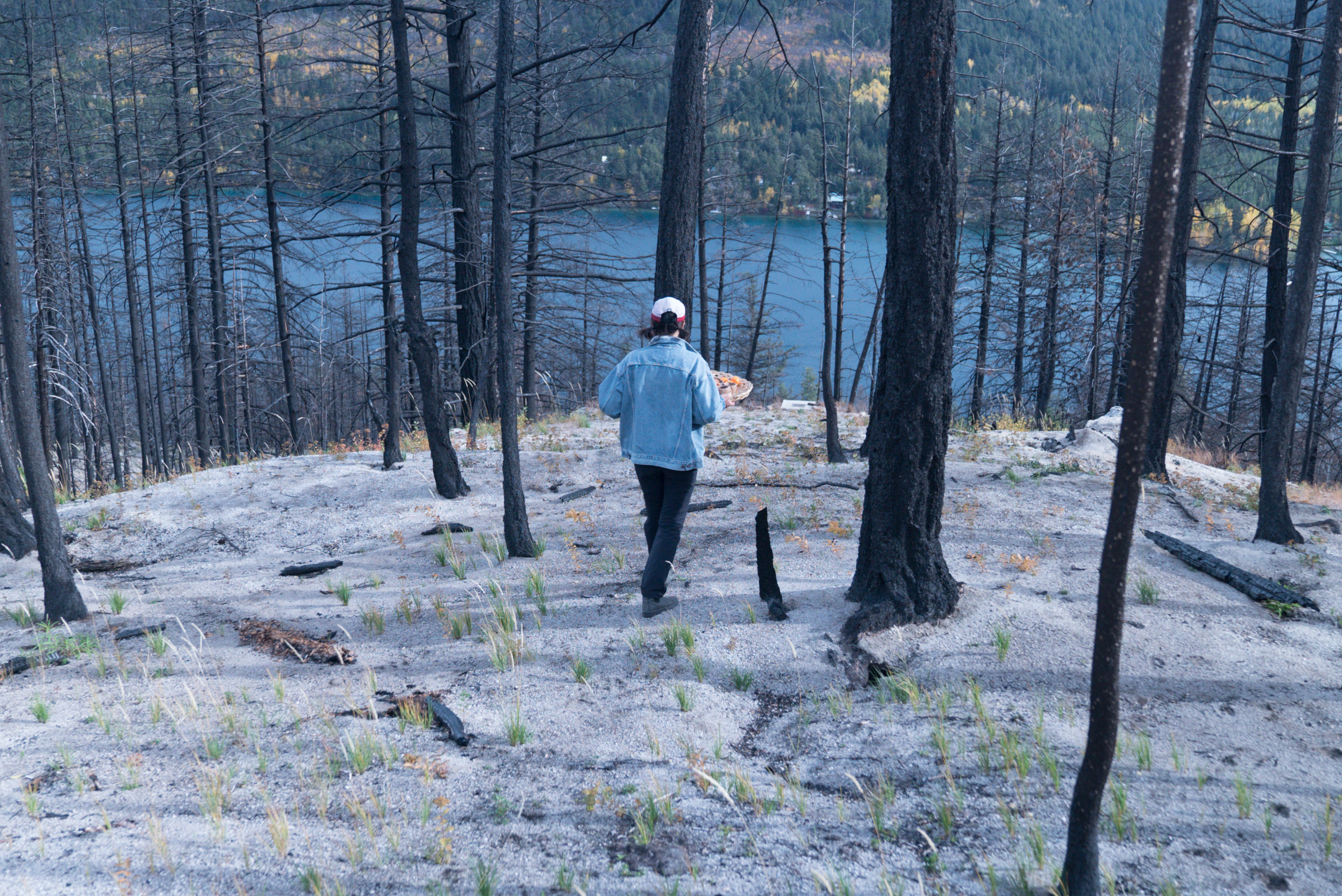
Gillian Der (謝美華 ) and Ragnar Kjartansson met through the good fortune of a bad wildfire. The pair found themselves in the burn scar of the 2023 Downton Lake Wildfire in British Columbia, Canada for a forthcoming piece by Kjartansson. Both calling active and hazardous landscapes home, they found common ground in the strange banality of living with environmental risk. What also emerged, however, was a shared interest in themes of repetition, magic, nostalgia, performativity, and masculinity that enabled them to talk across disciplines on how these themes show up in moments of environmental crisis.
Navigating everyday environmental disruption becomes the navigation of an uncertain relationship to place. During these moments of uncertainty, nostalgia (Ladino et al., 2022) emerges as a powerful force that materially shifts the outcome of living with environmental hazard. Feminist environmental intervention insists on feelings as legitimate environmental data (Neimanis & Hamilton, 2026) that creates both obstacles and opportunities to challenge western and masculinist tendencies toward dominion over nature (Plumwood, 2002). Der and Kjartansson saw an opportunity to fuse together environmental feminist theory with performance art and abstract expression to make sense of living with daily environmental risk. The pair discuss how environmental crises might push people into sincere performances of clichéd and nostalgic figures to insulate against uncertainty and maintain a sense of the everyday. Performance and abstract expression can reveal the absurdity of these tactics of living with environmental risk while encouraging instead a sober but humorous reckoning of living in hazardous times.
Banal Hazard: The spectacular normality of living in active landscapes
Gillian: I am curious if you could tell me a little bit about what life in Iceland was like immediately prior to the volcanic explosions starting in 2021. Was it something that you were primed for? How did the community react once this did start?
Ragnar: The peninsula south of Reykjavik, is a very active volcanic place. Iceland has the greatest imperialist expansion plan: we expand one centimeter a year. One day we're going to be a continent, my friend. The first eruption was not far away from Reykjavik or Grindavík. In the middle of it a gorgeous crater came up, and people would just flock over there. It was beautiful to come up there and just watch and have hot cocoa and look at that crater. It's just gorgeous.
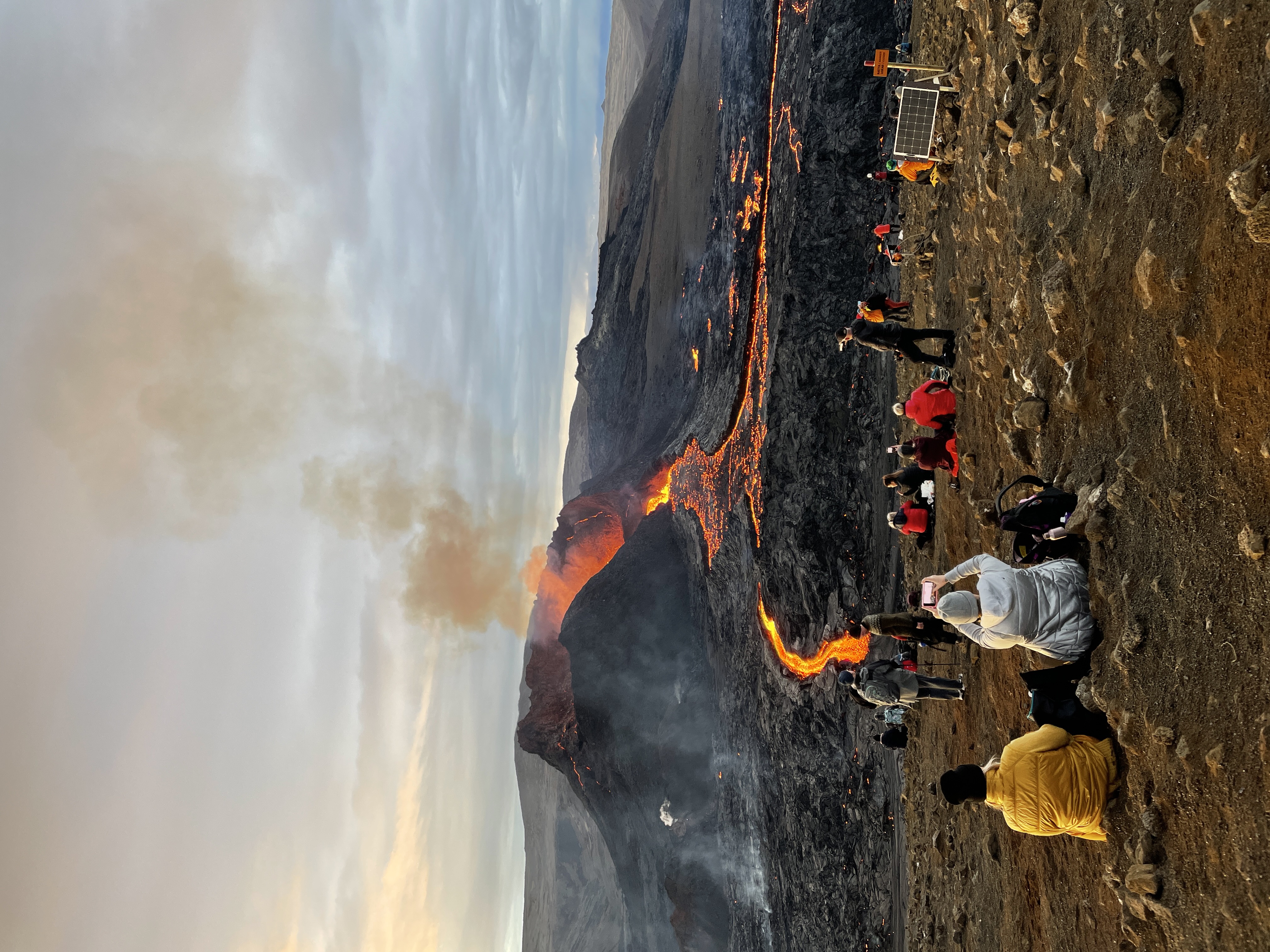
Just before it started, it was always on the news that maybe something was going to start. And, you know, people are kind of excited about it, but also going, “Ah, it's not going to start. They always say it's going to start. Yeah, yeah, yeah.” I remember, once being driven by a taxi driver who showed me the mountains and was like, “Remember, you think you're safe in Reykjavik, but look at these mountains, one day they will explode and lava will flow over our city” You know, taxi drivers are so dramatic.
There was a website which was always like a joke website. It was dark with just letters saying, “It's not erupting. It's not erupting” and then the moment it erupted, the website changed to, “It is erupting”.
Gillian: Who ran this website?
Ragnar: Just a funny person, I just love this: “It's not erupting. It is erupting”. That switch, that immediate switch, interesting. I remember when it came on the news that there was an eruption, everybody went to that website to check if that person had changed it. It sort of sounds like an art piece, but I think it was just somebody being funny. You know, very close often, art pieces and somebody being funny.
When there was an eruption in 2008 which caused air traffic to stop all over the world. There was a good story of a singer, at some art world dinner sitting next to some rich American lady who was just like “your volcano is making such a mess, I cannot go to Art Basel this year” or something like that and, “Isn't there something you can do about it you Icelanders?” the singer answers, “no there's nothing we can do about it it's just nature” and then the lady answers, “oh well I guess nature also makes mistakes.” I guess nature also makes mistakes because it's getting in the way of going to Art Basel.
Gillian: I find that you have this interesting tension in your work between repetition and the desire to create these very magical, spectacular moments. It feels very similar to environmental hazards: the first time the volcanoes erupted, it was this magical moment, and everyone went and saw it, and then once it repeats, something else happens to that event, and it becomes mundane.
Ragnar: I mean I remember going for morning coffee with my friends and it's like, you know, oh, there's the volcano. It was just like out the window.
Gillian: Yeah. We have a very similar thing in Vancouver with smoke. When the smoke comes in it has become very mundane. People start calling it “smoke season”, or “fire season” and people carry on with their days, in spite of very dangerous levels of particulate matter.
The Frontiersman, Violent Cliché and the Consequence of Nostalgic Landscape
Gillian: When we’d chatted previously about our own experiences with these kinds of mundane, but really disruptive environmental events, I was sharing how interesting it was that there were a lot of folks who did not obey or outright refused evacuation orders during the 2023 Downton Lake wildfire. My data found people were saying, oh, well, next time I wouldn't evacuate. I would stand and defend my property. Or it was all too overblown and there wasn't actually that much risk. I know that that was something similar in your community. Can you talk about that?
Ragnar: So that first one was kind of no danger to any man-made structures, but then they became so many in a row. I don't remember how many eruptions it was. Then they started being close to this town called Grindavík and then people started being evacuated. As soon as that happened, they kind of started this drama about why are you evacuating, you don't know what you're talking about. A lot of people understood this [evacuation] and let's be on the safe side and evacuate. It's mostly men who are like, “I want to stay here” and I mean, in a volcanic eruption, you cannot defend your property. It's like, no chance. Nothing you can do. I mean, also in a wildfire, you cannot be with a hose protecting your property.
Gillian: It's interesting this kind of masculinity that shows up. I'm really intrigued about how that works in an Icelandic context, because for me, I see that as, especially in a rural Canadian context, very closely linked to old stories about The Lone Frontiersman (Der, 2026).
But then, you're working in a completely different cultural context, and yet there's still that kind of machismo masculinity that you're noticing as well. I'm curious if you've linked that to any bigger set of stories that we replay and retell ourselves?
Ragnar: You know, when reading stories about eruptions, like from the 18th century and stuff, it doesn't seem to be this much machismo around it. So, I think it's just Hollywood.
Gillian: Can you say more about what it is in Hollywood?
Ragnar: Hollywood movies teach us: I'm gonna stay here and defend my property. If it's an alien invasion or a tornado or whatever, it's very often a character in Hollywood movies stays behind and defends the property. I think that narrative just goes into the head of everybody who's under the spell of Western culture.
There was an eruption in 1974 in the Westman Islands, south of Iceland. You never heard stories about those who stayed. I mean, there were those who stayed behind to try and rescue the village, but they were not like, “I'm not gonna leave my house.”
Gillian: It's so interesting how that culture floats along and informs evacuation procedures decades out from creation. Art and culture pokes holes into these environmental hazards and clearly changes the way that we engage with them.
I want to think about the kind of nostalgia that is imported into Iceland and already here [in Canada] in our colonial myths, and how that becomes a cliché and how cliché is a form of repetition. I'm curious to know why you're so interested in these cliches and this nostalgia. For example in your work The End (Kjartansson, 2009). Why are you so interested in nostalgia on the Canadian landscape as well?
Ragnar: I mean, I'm just interested in cliches mostly. There was an art piece that had a huge impact on me, by my mentor called Magnús Sigurðarson. It was a picture of him naked with a cigar and a finger up his butt, and it was called “The Cliché is the Ultimate Expression.” I saw that image and there was something in those words that just, something in me flicked about my interest in clichés and how they define our culture. Also from seeing works that play with cliché like Paul McCarthy (2013) and Mike Kelly, where a sweet cliché like Snow White is taken and made very violent.
For me, it's almost like, you don't need to make the cliché violent, it is already so violent, probably because I know this work, which is about playing with the darkness of clichés. When I see a Walt Disney movie it’s sweet and beautiful, but I know there's dark shit going on. That's what intrigues me about it, and that's what's fascinating about everything, it’s just drenched in pain.
It's not because I'm nostalgic myself, I'm interested in these nostalgic images that become clichés and very interested in the way we look at old times as something perfect and great, which of course it was not. A lot of my works come from the brutality of romantic paintings and romantic movies. I find the violence of beauty so interesting. Much of my work is playing with the brutality of sweetness in nostalgia and clichés, but it's very hard to pinpoint verbally what it is.
Gillian: Yeah, maybe we'll come back to that point. I think that what I'm hearing is that this nostalgia emerges beyond just an art piece; it's also a form of performance—a repetition of this imagined past.
When I research wildfire, it is to learn how to come to terms with how we live with wildfire. There was some research done (Ladino et al., 2022) on this tendency for nostalgia to derail what it looks like to live with wildfire. This team of writers looked at several different nostalgic figures that I really understood as characters in a play. They looked at the giant sequoia, the heroic firefighter fighting the good fight, and they looked at the frontiersman. That play is the kind of performance that William Cronon called bourgeois anti-modernism (Cronon, 1996). People dress up and perform as cowboys. It is this performance, this repetition of a nostalgic pull toward a libertarian, masculine, independent dominion over nature, that feeds these evacuation refusals.
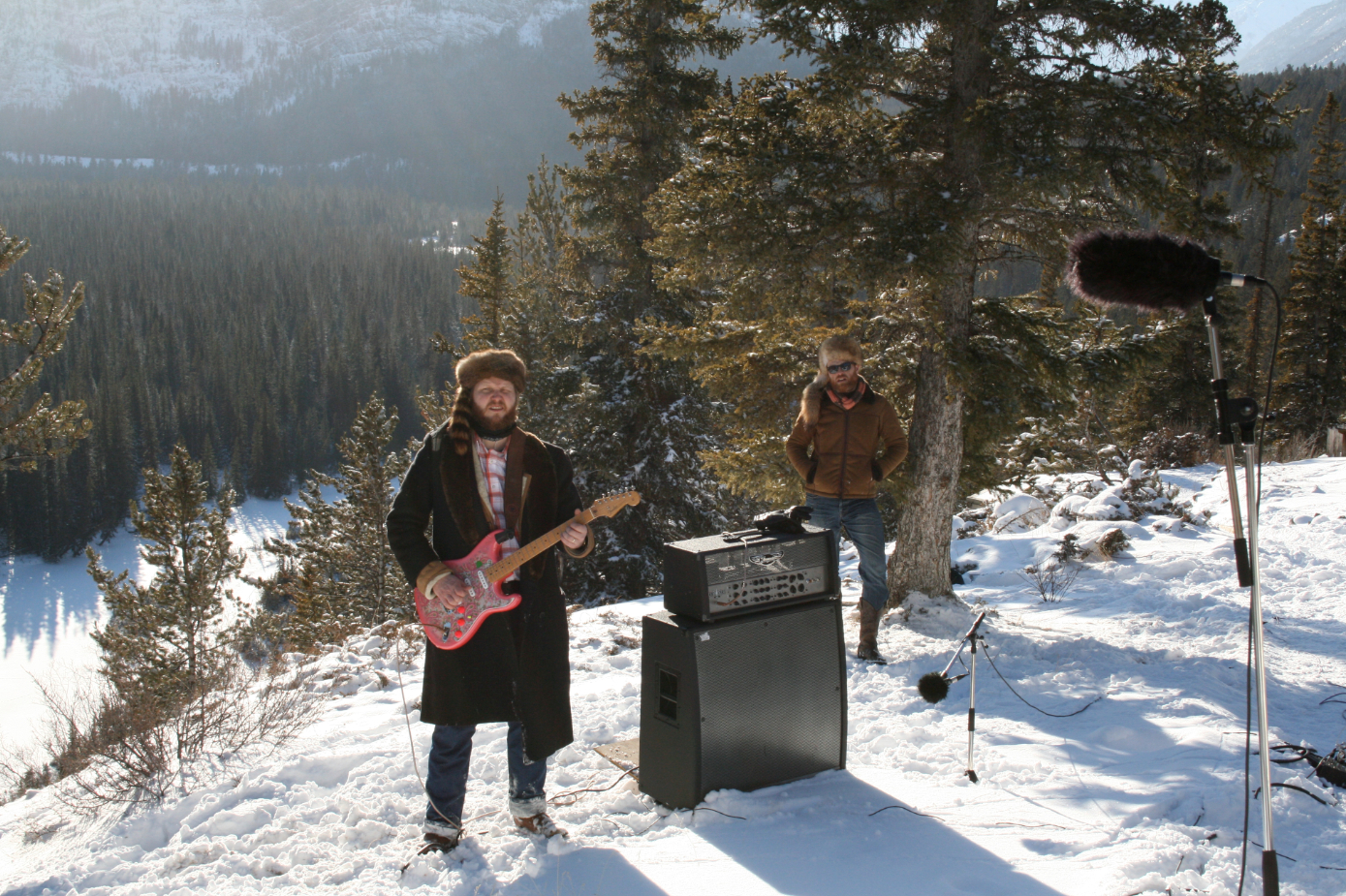
Ragnar: That's also the reason why, in a piece like The End, we would wear this kind of frontiersman clothes. I had been before in Banff and everything was just about the railroad. I found fascinating the violence of that culture. Therefore, it was a decision to wear this kind of outfit in it but it's not full on. We're wearing modern clothes, we're not wearing 19th century frontiersman clothes, but it looks frontier. There's this compositional element where you make things look as they are not meant to be a costume, but they actually are a costume.
It's interesting how cultures form characters. It's everywhere: you perform a culture that was there before. So therefore, there's play with costumes. I think clothes are interesting, like the message you tell is often a violent message. I remember being blown away by feminist art and then being blown away by the fact that I am the problem and I can play with being the problem. That’s why I use a lot of this imaginary of like frontiersman. These white man cliches. I'm playing with the cliche, the problem that I am.
Gillian: By taking that imagery and playing that role, you gain legitimacy. Which I think if we bring it back to these stories about mostly men refusing to obey evacuation orders, they're pulling from the older stories that give them legitimacy to do that. They're pulling from the colonial story, from the Hollywood story.
Ragnar: Yeah, you cannot take me off the land because I am also almost a token or I am the image of that frontiersman, and you cannot take the iconic frontiersman out of the frontier.
Gillian: because you can't go backwards in the frontier. You have to keep going forward. And so it [the performance] breaks.
Policy, Performance, and Precarious Futures: Attempts to Insulate Against Uncertainty
Gillian: We've talked a lot about the repetitive history of these environmental events and the inclinations of the people experiencing them to repeat history in these strange performances. But I think there's also this kind of sublime magic that comes around from environmental hazards. You create moments [in your art] and these natural hazards create moments. I'm curious what your thoughts are, if those moments of hazard still possess some kind of magical quality or if you find that's kind of fading with normalization?
Ragnar: Now it fades when you're in it. The next time it happens, I will feel like yeah [eyes widen with excitement] because when you get a pause, the magic comes again. If there would be an eruption now, I wouldn’t be stressed about going to see it. I saw two in the last six years. But there is always magic. We become so small when nature takes over.
There's more uneasiness about wildfires. How they are happening now is caused by humans. So, they are in that sense related to war. It's not only nature, it's also manmade.
Gillian: Can you say more about War? Why specifically war?
Ragnar: War is something that men do to each other. Wildfire is so severe because of global warming and because of all the logging. The wrong way the land has been used in logging through the years. These two manmade scenarios make it so much more dramatic than it should be. Therefore, it has this sense of manmade disaster. Then it's somebody's fault—but who can we point at?
Gillian: I mean, we can point directly to colonization as the cause. The removal of good fire and Indigenous fire from the landscape is directly related to this fuel loading that we're experiencing. So, there are ways to find blame, I guess, but I don't know how helpful that is in finding the solution.
Ragnar: No, I don't think it's helpful in finding the solution. I'm just talking about it as a feeling. It's a feeling opposed to a volcano where you're just totally helpless. You cannot point at anyone. But interestingly enough, you very soon start pointing.
When there was a volcano here in Iceland, in Grindavík, the town people had to evacuate. For such a long time there was so much uncertainty that the state decided to buy the houses of the people in that village to save people from total uncertainty. It was a huge financial decision by the government, and I think a really good decision so people in the village could go on with their lives elsewhere, but still people were so angry. People started to be so angry at the government for something. For all that they had, their houses have been paid for, but it was just this sorrow. Your home has been taken away from you, and you want to put the blame on something human because it's very hard to just blame it on nature. You want to blame some humans for it and be angry at the Prime Minister or the Minister of the Interior or something. Of course, there are mistakes made but I just found it interesting how furious people get at the government although they are obviously trying very hard in a crazy dilemma
Gillian: Yeah, it is definitely also the case here. People's houses are not bought, but I think there's the same kind of anger. To me, when I hear that, that also goes back to this idea of nostalgia. Nostalgia also insulates against that uncertainty. Having permanence, if that's in the way of a home or in a familiar cliché figure. There are parallels to the performances and repetition that we were talking about that are reenacted in a time of uncertainty while also fueling legitimacy to stay behind and remaining in what is certain.
Ragnar: I understand it also. Now there’s this talk about the sea currents are changing because of global warming and then Iceland will become uninhabitable and then I will just have to leave, my children will just have to leave. It's just such a scary thought.
Gillian: That endangers those old stories. It means you can’t repeat. It means that the everyday is no longer. There's no frame for what the everyday is.
Ragnar: And you start to think, will this not be like this in the future? Maybe not in my life, but maybe my grandchildren's life. It's a melancholia that really comes over you. It reminds me of the nuclear threat melancholia of the 1980s. I remember being a kid, I was looking at the world around me like, maybe all this will be gone.
Gillian: Regardless of if that's human made or if that's an inevitable reality of your seismic situation, that fear is what these nostalgic performances insulate against. When you re-perform or repeat these old stories, then it isn't gone. The repetition enlivens the good old days and brings the good old days back into the present.
“Art Has to be Comforting”: The Magic of Mundane Absurdity
Gillian: You mention the idea of “mundane absurdity” a lot, and I'm just curious if you can define that term for me?
Ragnar: It's sort of like the backside of the coin of magic. You can always find magic in the mundane, and you can also find the mundane in the magic. Like seeing a plastic bag in the wind in a suburb is totally glorious and magical and then being bored at sunset by the Grand Canal drinking a glass of champagne. Everything can become mundane. That's what's interesting.
Gillian: And how do you use that tension in your work?
Ragnar: I use it a lot. I never thought about how I use it. It's a very good question. It's one of the ingredients I like to compose it with. Probably it has to do with I was raised so much with religion and mysticism. There was the thing where you realized it was all a performance; it was all theater. It was actually mundane.
There's a light in the Catholic church which is always red. I was told that God is in that light. Then you see a nun come and change the candle. The job I had as an altar boy was to ring the bell when the priest lifts the sacrament. The moment the priest lifts the sacrament, you ring the bell because that's the moment when the bread actually becomes the body of Christ. It's the ultimate magic thing. But it was just mundane, it's not becoming [the body of Christ]. You have to believe. You have to pretend. I was fascinated by religion a lot when I was growing up. The best advice I ever got was from one priest who told me, “Ragnar, always when you make a mistake, pretend it's ceremony.”
Gillian: I love that. I feel like that leads well into the last question that I have. We spoke briefly about how you couldn't quite put words to cliché and the brutality of sweetness, so I wanted to ask a bit about abstraction. How do you think abstraction through art, through these images, through these performances that you create can poke at this kind of “mundane absurdity” of a day-to-day life while we're living in an increasingly hazardous environment?
Ragnar: I've never said this out loud but I almost think art has to be comforting, you know. Yeah, you're poking at it and you're deconstructing it but trying to make it magical at the same time. You're trying to do both things. We live in hazardous times. There's something about creating comfort in all this sorrow in world around us and the human state, be it in hazardous times or not.
It creates comfort for me. Creating, makes me feel better. You know the drill, there's nothing more pathetic than using art as therapy. But I like this Edvard Munch notion that you face the brutality of life through art. So you try to look brutal things in the eye, and then humor almost comes into it. It's like looking brutality in the eye and not laughing at it, just giving it a…
Gillian: Side eye?
Ragnar: Giving it a side eye, yeah. I think it's like, okay, it's an abyss. I see, it's an abyss. Okay.
Gillian: Side eye into the abyss, and the abyss will side eye back at you.
References
Cronon, W. (1996) ‘The trouble with wilderness; or, getting back to the wrong nature’, Environmental History, 1(1), pp. 7–28. doi: 10.2307/3985059.
Der, G. (2026) ‘Fire truck nationalism: how to stay a hero when you lose to a fire’, Network in Canadian Environmental History, 13 July. Available at: https://niche-canada.org/2026/07/09/fire-truck-nationalism/.
Kjartansson, R. (2009). The End Rocky Mountains [Multi-channel film].
Ladino, J., Kobziar, L.N., Kredell, J. and Cohn, T.C. (2022) ‘How nostalgia drives and derails living with wildland fire in the American West’, Fire, 5(2), article 53. doi: 10.3390/fire5020053.
McCarthy, P. (2013). White Snow, Bookends [Sculpture].
Neimanis, A. and Hamilton, J.M. (2026) How to Weather Together: Feminist Infrastructure for Climate Change. London: Bloomsbury Academic.
Plumwood, V. (2002) Feminism and the Mastery of Nature. London: Routledge.
Author Bios
Gillian Der 謝美華 is an independent researcher residing between Musqueam, Squamish, and Tsleil-Waututh territory and St'at'imc territory in so-called British Columbia, Canada. Gillian’s research focuses on how environmental hazards and our changed climate intersect with gender, race, coloniality, class, and disability. She is particularly interested in the volumetric and elemental turn in geography and is curious to know how the shifting atmospheres around, above, beneath, and between us might inform affective solidarities between human and non-human beings. Her arts-based and community engaged methods of inquiry draw heavily from her background as a community organizer and artist. In 2025, Gillian received her MA in geography from The University of British Columbia for her research on the 2023 Downton Lake Wildfire. Her academic writing can be found in NiCHE - Network in Canadian History & Environment and FireSeason IV. She is a shortlisted author for the Malahat Review’s 2025 Open Awards in Non-fiction for her piece “Third Child”. This fall, she is excited to begin her posting as a Citizen Poet for the City of Vancouver in partnership with Simon Fraser University’s Belzberg Library.
Ragnar Kjartansson draws on the entire arc of art in his performative practice. The history of film, music, theatre, visual culture and literature find their way into his video installations, durational performances, drawing and painting. Pretending and staging become key tools in the artist’s attempt to convey sincere emotion and offer a genuine experience to the audience. Kjartansson’s work has been exhibited widely. Recent solo exhibitions and performances have been held at the Louisiana Museum of Modern Art, Kunstmuseum Stuttgart, Metropolitan Museum of Art New York, Barbican Art Gallery in London, Hirshhorn Museum and Sculpture Garden in Washington DC, Reykjavik Art Museum, Palais de Tokyo in Paris, and New Museum in New York. Kjartansson was born in 1976 in Reykjavík and studied at the Iceland Academy of the Arts and The Royal Academy, Stockholm.
Recommended Citation
Der, G. and Kjartansson, R. (2026) ‘The “Mundane Absurdity” of Everyday Life in Hazardous Times’, Everyday Life: International Journal of Public Culture, Art and Design, 1(1), pp. 1–15.
Copyright
© 2026 The Author(s). Published by Everyday Life: International Journal of Public Culture, Art and Design. This is an open-access article distributed under the terms of the Creative Commons Attribution-NonCommercial 4.0 International Licence (CC BY-NC 4.0), which permits non-commercial use, distribution and reproduction in any medium, provided the original work is properly cited. Everyday Life is an independent open-access journal with no submission or publication fees.